Hello, and welcome to my review of Chaikin Analytics.
If you’ve seen the ads, you’ve probably noticed two things right away: Chaikin Analytics is built around Marc Chaikin, and it heavily promotes his “Power Gauge” system.
That’s why it can be tricky to evaluate. Chaikin Analytics isn’t a simple newsletter where you subscribe and follow a short list of stock ideas. It’s a tool-based platform built around ratings, signals, and ongoing updates. That can be useful if you like a more hands-on approach. But it’s less ideal if you want something more straightforward and buy-and-hold.
In this review, I’ll share the 6 key things to know before joining, including who Marc Chaikin is, what his “predictions” and stock picks actually look like in practice, what you get for the price, and who this platform is best for.
I’ll also share a straightforward alternative to consider if you’d rather focus on a smaller number of well-chosen investments, instead of relying on ongoing signals and constant updates.
See My Top Recommendation6 Things to Know Before Joining Chaikin Analytics
I’ve reviewed hundreds of stock newsletters and research services over the years, and one thing is clear: small differences in approach can lead to very different experiences.
That matters here because Chaikin Analytics isn’t a single newsletter. It’s a tool-based platform built around the Power Gauge, with different membership levels and offers. So what you’re really evaluating is the specific offer you’re about to buy.
Below are the 6 things to know before joining, so you can quickly decide whether it’s a fit.
(1) Who Is Marc Chaikin?
According to his own site, Marc Chaikin is a veteran market analyst with decades of experience. He is best known for creating widely used indicators such as Chaikin Money Flow and for the “Power Gauge” system that Chaikin Analytics is built around.

In his presentations, Chaikin emphasizes his experience and highlights past calls he believes helped investors spot risk earlier or avoid major drawdowns. He also positions the Power Gauge as a practical way to filter stocks when markets feel noisy or uncertain.
His core message is simple: today’s market can be hard to navigate, but his Power Gauge uses a multi-factor rating system that can help you narrow the field and focus on stronger opportunities.
It’s a compelling story, but the real question is: how have his stock picks actually performed?
(2) What Are Marc Chaikin’s Stock Picks?
Most people land on Chaikin Analytics after seeing a presentation that teases one “can’t-miss” stock or a bold market call. The pitch is usually that the Power Gauge can help you spot stronger stocks “ahead of the crowd.”
But in practice, the “picks” you see inside the service are mostly system-driven.
Chaikin’s core engine is the 20-factor Power Gauge, which rates thousands of stocks as bullish, neutral, or bearish based on recent data (earnings trends, price strength, analyst revisions, institutional activity, etc.). So the “picks” are typically whatever the model currently likes, rather than a short, timeless list of hand-selected, high-conviction buy-and-holds.
So, how have those picks done?
Chaikin Analytics highlights some strong examples in its marketing, and there have been wins. But when you look at the broader picture inside the member area, the results can look more mixed than the presentations suggest.
For example, when I went through the archived 2025 sell alerts (closed positions) for the flagship Power Gauge Report service, I counted a blend of gains (including +22%, +25%, +79%) alongside multiple double-digit losses (down to –31%). Added together, the year came out close to flat.
(3) How Does Chaikin’s Power Gauge Work?
At its core, the Power Gauge is a multi-factor rating system. It scores stocks using a basket of inputs (fundamentals, earnings, technicals, and other market signals), then rolls that into a simple rating of bullish, neutral, or bearish.
You also get a breakdown of how the Power Gauge rates a stock’s financials, earnings, and technicals, plus some analyst context and charts.
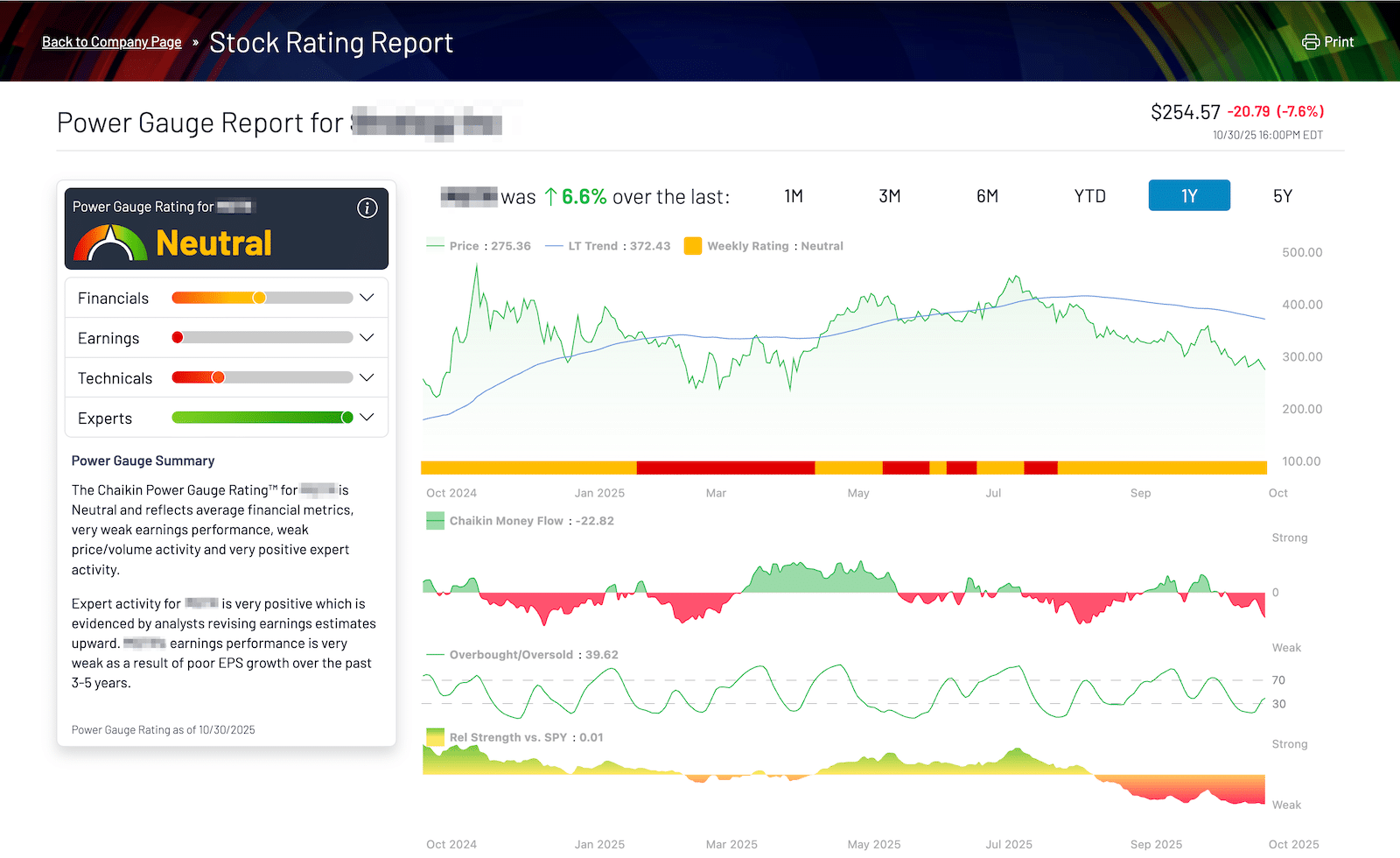
The key thing to understand is that Chaikin’s Power Gauge is designed to be a filter and a ranking tool, not a crystal ball. In other words, it’s trying to help you narrow thousands of stocks down to a shorter list that fits the model’s criteria right now.
That can be useful if you like a more active, data-driven process. But it also means the “best” stocks in the system can change as the signals change, which naturally pushes you toward ongoing monitoring and updates rather than a longer-term buy-and-hold approach.
(4) What Do You Get (and What Does It Cost)?
Chaikin’s flagship service is the Power Gauge Report, which gives you access to:
- The Power Gauge stock rating tool (bullish, neutral, bearish)
- The member area, where you can look up tickers and see the rating breakdown
- A model portfolio of stock picks you can reference
- A monthly newsletter with a writeup on Chaikin’s latest pick and research
- Updates/alerts as ratings change or positions are adjusted
The standard price is typically $499 per year, but Chaikin Analytics runs promotions often, and it’s not unusual to see a much lower first-year price (sometimes as low as $149 or less).
The subscription also comes with a 30-day refund policy, so you can explore the tools and see if the system fits your style.
After joining, you will likely see some optional upgrade offers. Some of these add-ons are priced at $5,000 per year each (examples include Power Gauge Investor, PowerProfits, PowerTactics, and Smart Money Trader), plus other services. These upgrades are optional, but the promotions are ongoing once you’re in their ecosystem.
(5) Is Chaikin Analytics Legit and Worth It?
Chaikin Analytics is a real, established platform, built around Marc Chaikin’s Power Gauge system. It’s not a fly-by-night operation, and the service itself is a structured tool that rates stocks based on a defined methodology.
That said, a service can be legitimate and still not be a good fit for every subscriber, especially when it’s promoted in a bold manner that doesn’t always set the right expectations.
If you look at the company’s Trustpilot rating, it’s lower than many subscribers would expect:

I don’t treat review sites as the final word on any investment product, because they tend to reflect people who had a strong experience one way or the other. But it’s still a useful signal that some subscribers felt the value didn’t match their expectations, or that the marketing and follow-on promotions were more aggressive than they wanted.
So, is it worth it?
If you’re the kind of investor who likes a structured, data-driven system and you’re willing to use it actively, you may find real value in the Power Gauge as a screening and ranking tool.
But if you’re hoping for a simple, straightforward “buy these few stocks and forget about them” experience, Chaikin Analytics can feel like more moving parts than you need. The safest mindset is to treat the Power Gauge as a filter, not a guarantee.
(6) Who Is It Best For (and Who Should Skip It)?
Chaikin Analytics is best for investors who like a structured, data-driven approach and don’t mind being more hands-on.
If you enjoy using a rating tool to filter ideas, checking signals as conditions change, and staying engaged with ongoing updates, you’ll likely get the most out of the Power Gauge. It can also be a decent fit if you prefer having a system to guide your decisions, rather than following a smaller number of analyst picks with a longer-term thesis.
On the other hand, Chaikin Analytics is less ideal if you want a simple, buy-and-hold experience built around a small number of clear ideas you can hold with conviction. The whole point of the platform is that ratings and signals can change, which naturally nudges you toward more monitoring and decision-making over time.
It’s also not a great fit if you’d prefer to avoid frequent promotions or the possibility of higher-priced upgrades. Even if you stick with the entry product, it’s reasonable to expect ongoing marketing.
If what you really want is a more selective, long-term approach built around a small number of well-chosen opportunities, there may be better options to consider.
Is There a Better Alternative?
I’ve reviewed hundreds of investment newsletters over the years, and while many are built around big themes and bold predictions, only a small number take a more selective approach to uncovering exceptional opportunities before the crowd catches on.
One analyst whose work has stood the test of time is Mark Skousen.
Skousen is a veteran economist, bestselling author, and former CIA analyst who has spent decades in elite financial circles.
Over the past four decades, he has built a long-standing reputation for spotting major trends and investment opportunities before they become widely recognized.
Right now, Skousen is focused on a little-known SpaceX play that he believes could be like investing in Tesla in the early days, and he just released a new presentation showing how ordinary investors can get positioned early, before the broader market catches on.
Click here to watch the full presentation now (free ticker revealed):