Hello, and welcome to my review of Growth Investor.
If you’ve seen Louis Navellier in one of his promotional videos, you’ve probably seen him warning about major market events and recommending stocks he believes could rise.
Most of those promotions lead back to Growth Investor, his flagship stock advisory service.
In short, Growth Investor is a data-driven stock advisory service built around Navellier’s quantitative system for finding large-cap growth stocks. Members get access to monthly newsletter issues, model portfolios, research reports, and his Stock Grader tool.
Is it legit and worth it?
I joined to find out. And in this review, I’ll show you the six key things I learned after getting access, so you can decide whether Growth Investor is right for you.
I’ll also share another service I think is worth considering if you prefer a more focused set of high-conviction stock ideas instead of tracking dozens of positions.
See My Top Recommendation(1) Who Is Louis Navellier?
Louis Navellier is a long-time market analyst, money manager, and newsletter publisher best known for his quantitative, rules-based approach to stock picking.

His stock-picking services are published through InvestorPlace, a financial publishing company that operates a range of investment research products.
According to Navellier, his interest in stock research began in college, where he used Wells Fargo’s mainframe computers to build early stock-selection models. That research eventually became the foundation for his newsletter work, including Growth Investor, which he launched in 1998.
Louis Navellier’s reputation is built around using data to rank stocks based on measurable business and market factors, which helps explain the overall style of Growth Investor.
It’s more of a broad, data-driven stock advisory service with a large model portfolio than a newsletter focused on a small number of specific, high-conviction investment ideas.
(2) What Is Growth Investor?
Growth Investor is Louis Navellier’s flagship stock advisory service.
It’s designed to help subscribers build a broad portfolio of large-cap growth stocks and dividend-paying companies using Navellier’s quantitative stock-ranking system.
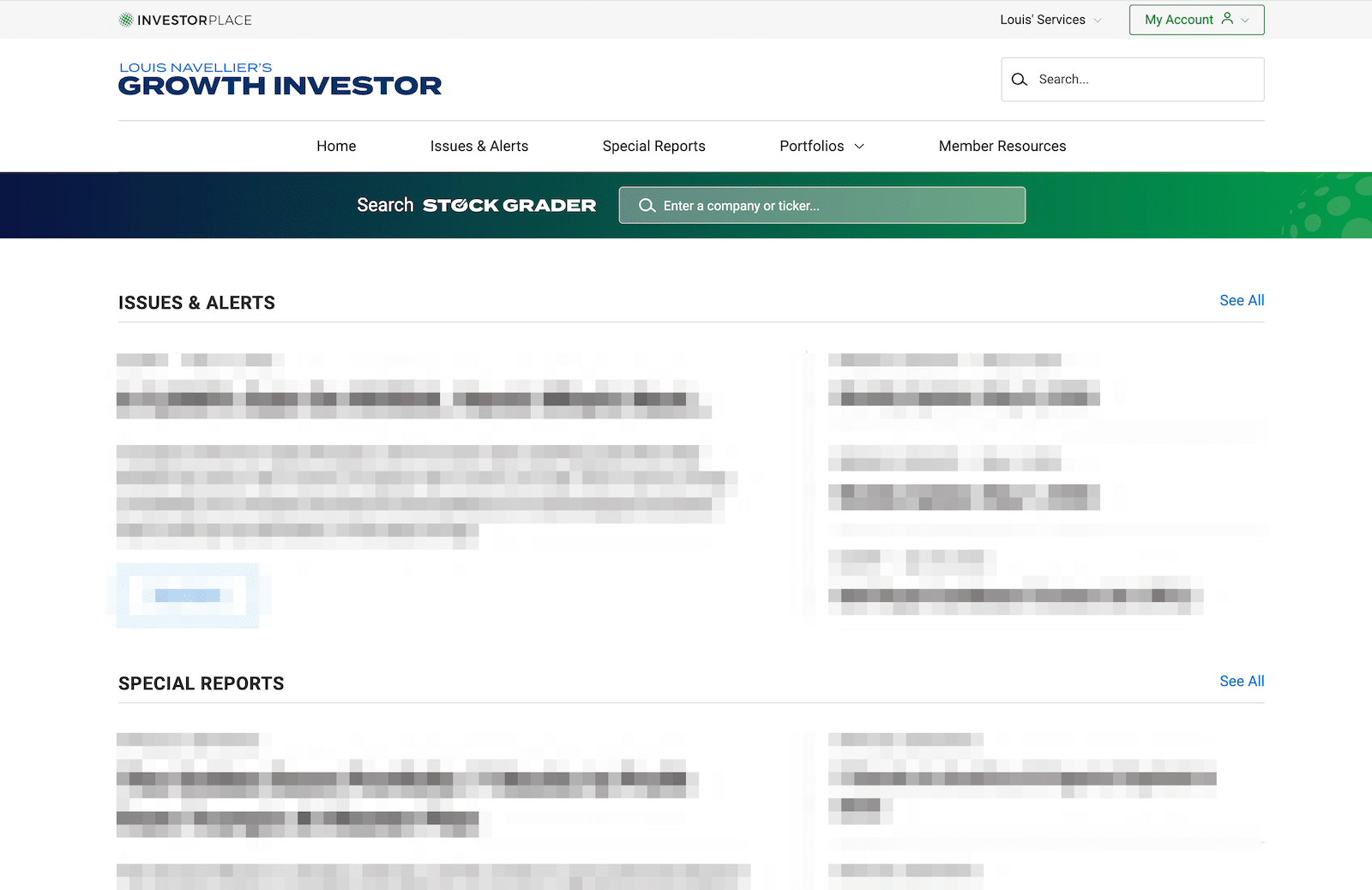
Inside the Growth Investor members’ area, the service is organized around several main parts:
- Newsletter: Monthly issues where Navellier shares new recommendations, portfolio updates, market commentary, and his top stock ideas for the month.
- Research reports and updates: Special reports focused on specific investment ideas, plus updates whenever there are important changes affecting the portfolio.
- Model portfolios (stock picks): Growth Investor includes two main buy lists: High-Growth Investments and Elite Dividend Payers. This is where you see his active stock picks.
- Stock Grader: This is an “add-on” that comes with Growth Investor. In short, it’s a stock-rating tool that lets you look up thousands of stocks and see how they rank based on his system. It also forms the basis of Navellier’s core approach to stock picking.
Overall, Growth Investor feels more comprehensive and polished than many stock advisory services I’ve reviewed. The member area is easy to navigate, the main sections are clearly organized, and there are guides that explain how the service works.
But a polished member area only matters so much. The real question is whether Navellier’s stock picks are any good, so let’s look at the model portfolio next.
(3) What Are Louis Navellier’s Stock Picks?
Louis Navellier runs multiple stock advisories, but inside Growth Investor, the stock picks are organized into two main model portfolios: High-Growth Investments and Elite Dividend Payers.
Each portfolio is then split into three risk categories, each with a recommended allocation:
- Conservative Stocks (60%)
- Moderately Aggressive Stocks (30%)
- Aggressive, Powerful, Volatile Stocks (10%)
At the time I checked, the High-Growth Investments portfolio had 35 open positions. These were spread across several sectors, including technology, semiconductors, engineering and construction, aerospace and defense, energy, gold/mining, biotech, insurance, travel, and industrial equipment.
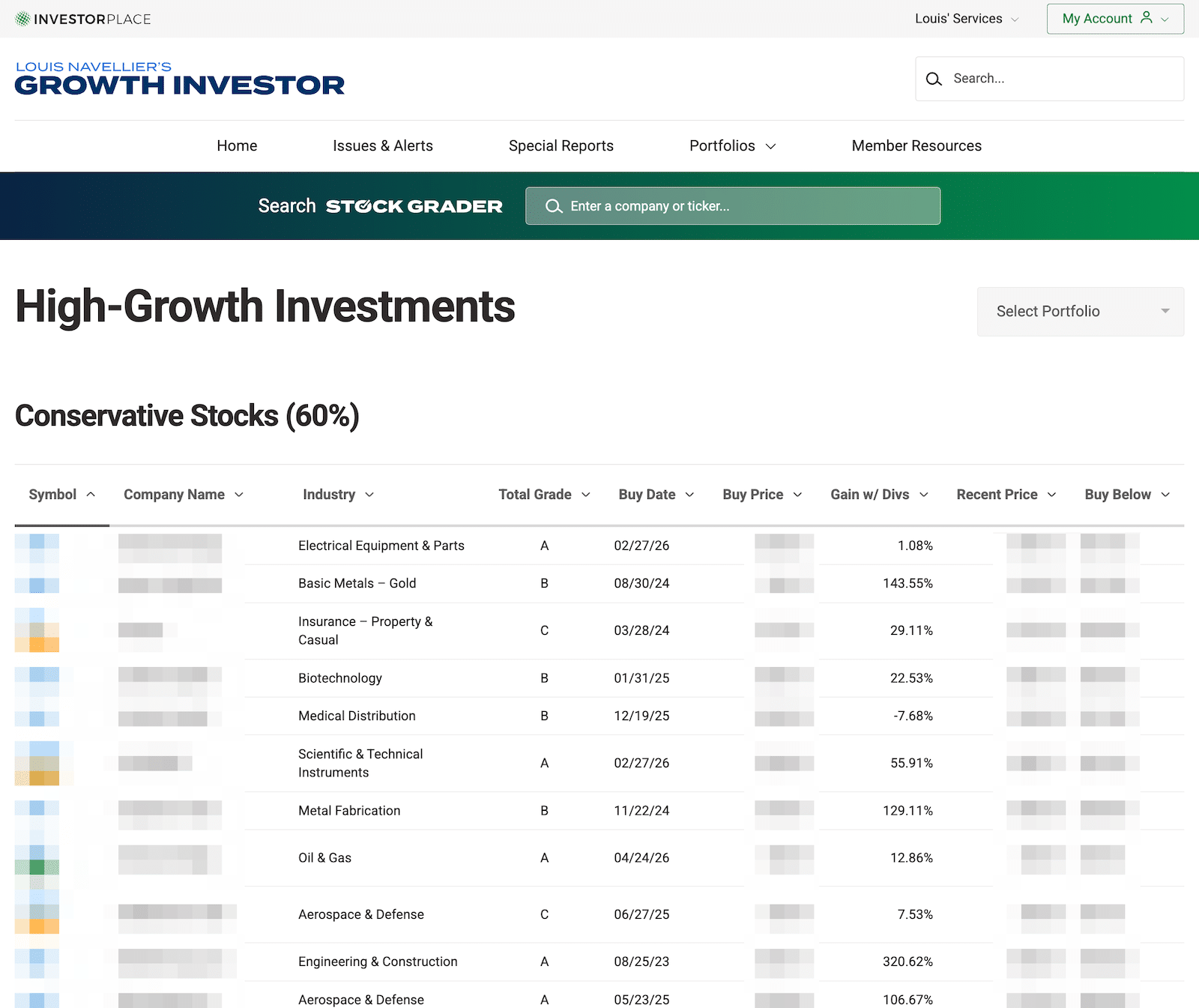
This portfolio is clearly not just a narrow “tech stock” list.
There are some growth-oriented names and AI-adjacent businesses, but there are also companies tied to infrastructure, defense, energy, metals, healthcare, and financial services.
Here are the reported average returns across all three “High-Growth” categories. These figures are continually updated by InvestorPlace, but they were accurate when I reviewed the portfolio:
- Conservative Stocks: 382.21%
- Moderately Aggressive Stocks: 96.26%
- Aggressive, Powerful, Volatile Stocks: 122.72%
The Elite Dividend Payers portfolio is much smaller, with 12 open positions when I checked. These picks were focused more on income-producing companies across areas like financial services, semiconductors, oil and gas midstream, credit services, insurance, and energy services.
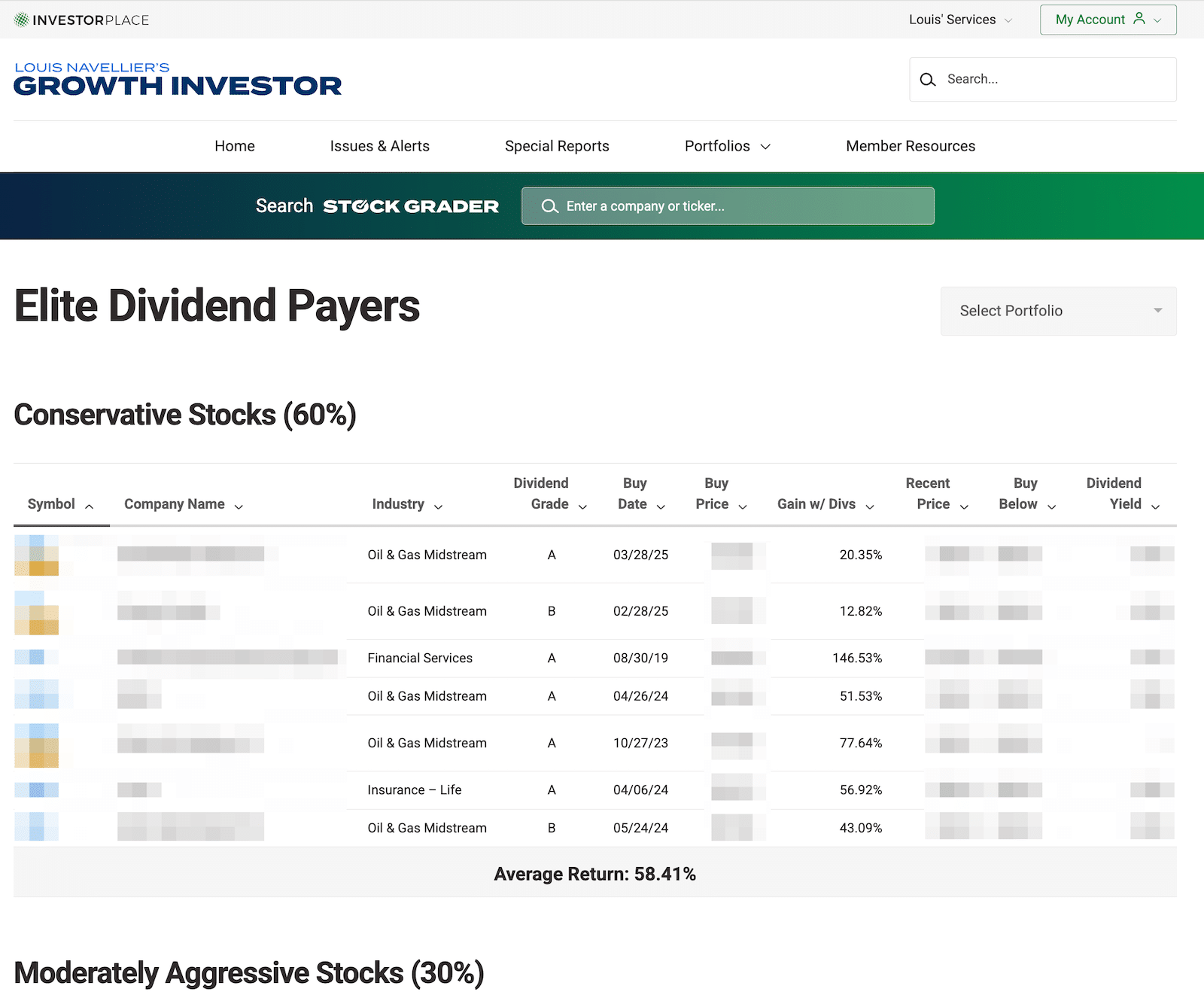
The reported average returns were also positive across the dividend categories:
- Conservative Stocks: 58.41%
- Moderately Aggressive Stocks: 222.87%
- Aggressive, Powerful, Volatile Stocks: 44.63%
So, in total, Growth Investor had 47 open stock picks across the two main portfolios when I reviewed it (or six portfolios if you count the different risk-based sections).
It’s worth noting that these are only the current open positions inside the model portfolios. They do not show every recommendation Navellier has ever made, and they do not provide the full historical performance of the service. So they are really only a snapshot of the current open portfolio.
To get a better sense of the closed trades, you need to dig through the archived alerts and monthly updates. For example, two recent sell alerts I found showed very different outcomes: one stock was sold for about a 147% gain (April 2026), while another was sold for about a 43% loss (March 2026).
That is useful context. Growth Investor has some very strong winners, but as with any stock advisory service, it also has some losing trades.
Next, let’s look at how these stocks are selected in the first place, because this is one of the main things that makes Growth Investor different.
(4) How Does Navellier’s Stock Grader Work?
Stock Grader is Louis Navellier’s stock-rating tool.
You enter a ticker, and the tool displays an interactive chart of the stock, a “Total Grade” (A-F), and a history of the company’s grade over time. Here’s an example of a well-known stock, Walmart:
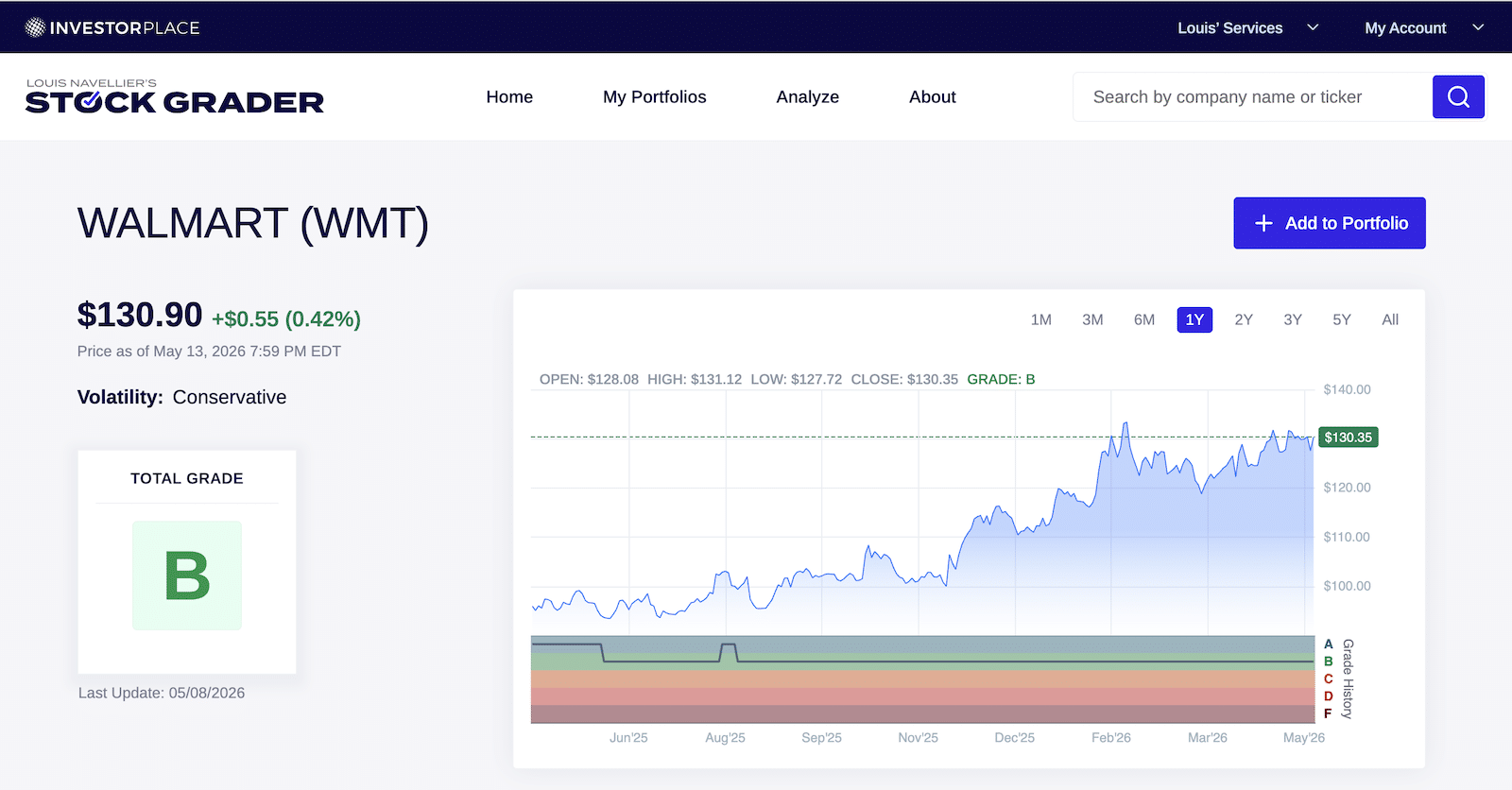
The Total Grade shown above is derived from the “Fundamental” and “Quantitative” grades. Here’s a quick breakdown of what each one means:
- Fundamental Grade: based on business and earnings metrics like sales growth, operating margin growth, earnings growth, earnings momentum, earnings surprises, analyst earnings revisions, cash flow, and return on equity.
- Quantitative Grade: based on buying pressure, which Navellier describes as “following the money.” Navellier’s philosophy is that a stock with great fundamentals “does not always go up,” but institutional buying pressure is “what moves great stocks higher.”
You can also browse several pre-defined portfolios, or add your own holdings to the tool and have it grade your own portfolio. That makes it useful beyond just Growth Investor, because you can check how your existing stocks look according to Navellier’s system.
The upside is that this gives Growth Investor a clear, repeatable process. You can see why certain stocks fit Navellier’s model, and you can track when ratings improve or weaken.
The trade-off is that Stock Grader is still mostly based on measurable data. That means it may be better at identifying companies that already have strong fundamentals and buying pressure than spotting under-the-radar opportunities before the numbers tell the full story.
(5) How Much Does Growth Investor Cost?
The listed retail price for Growth Investor is $499 per year.
However, the price you pay often depends on the promotion you join through. In my case, I paid $49 for the first year, and my subscription renews at $199 per year after that.
I also had a 90-day refund period, although I would still check the terms on the order page before joining, since pricing and refund terms can vary by promotion.
One thing to know is that Growth Investor is part of the larger InvestorPlace ecosystem, and there are quite a few upsells after you join. Some of Navellier’s higher-priced services include:
- Breakthrough Stocks: $4,000 per year
- Accelerated Profits: $4,000 per year
- Platinum Growth Club: $9,999 per year
So Growth Investor is the lower-cost entry point into Navellier’s research, but it is not the only service he offers. If you join, you should expect to see promotions for more expensive InvestorPlace and Navellier services over time. These aren’t essential, though.
(6) Is Growth Investor Legit and Worth It?
Yes, Growth Investor is legit.
After joining, I was able to access the members’ area, review the current model portfolios, read past issues and alerts, use Stock Grader, and see how the service is organized.
It is not just a basic newsletter with a few stock ideas. Growth Investor is a real stock advisory service that provides genuine value. And based on the current model portfolio I reviewed, many of the open positions have seen impressive gains over time.
That said, InvestorPlace does have mixed customer reviews online. When I checked, its Trustpilot profile showed a 3.1 average rating from 825 reviews.

I would not use that alone to judge Growth Investor, but it is worth being aware of, especially since InvestorPlace runs a large financial publishing business with multiple services.
So, is Growth Investor worth it?
I think it may be worth considering if you want a broad, data-driven stock advisory service with dozens of portfolio ideas, regular updates, and a system for ranking stocks. It may also appeal to those who want a diversified portfolio of large-cap stocks with long-term potential.
On the other hand, if you are looking for a smaller number of high-conviction investment ideas, or a more focused opportunity with bigger potential upside, there may be better options.
Is There a Better Alternative?
I’ve reviewed hundreds of stock advisories over the years, and what I’ve found is that while many make bold claims, the actual experience after you join doesn’t always live up to the hype.
That’s why I focus on analysts with a proven track record.
One analyst whose work has stood the test of time is Dr. Mark Skousen.
Skousen is a veteran economist, bestselling author, and former CIA analyst who has spent more than four decades helping readers identify major trends and under-the-radar investment opportunities before the crowd catches on.
Right now, Skousen is focused on a little-known stock trading around $5 that recently signed a major six-year supply deal with Tesla.
In his latest presentation, Skousen explains why this story could be bigger than most investors realize, and why he personally bought 10,000 shares.
You can watch the full presentation here: