Hello, and welcome to my review of the Power Gauge Report.
Chaikin Analytics markets the “Power Gauge” as a stock rating tool that can help you quickly separate stronger investment opportunities from weaker ones.
And Marc Chaikin says it’s the culmination of his 50+ year career on Wall Street.
That’s the pitch.
But does the Power Gauge actually help you pick better stocks? Or is it just another rating system that sounds good on paper, but doesn’t meaningfully change your results?
I joined the service myself to find out. And below, I share the 6 key things to know before joining to help you decide if it’s right for you.
I’ll also share my top alternative for investors who prefer a more selective, high-conviction approach focused on a smaller number of high-potential stocks.
(1) What Is the Power Gauge Report?
The Power Gauge Report is a paid stock-picking service built around Marc Chaikin’s “Power Gauge” rating system.
At its core, it’s a rating-driven approach: stocks are scored using a set of quantitative factors, then organized into simple categories meant to highlight which names look stronger and which look weaker. It’s basically designed to help you decide which investments to buy, hold, or sell.
As a member, you’re getting two things: the ratings themselves through the Power Gauge system, and the ideas and updates built on top of those ratings through the monthly newsletter. Both are made available inside the Chaikin Analytics members’ website.
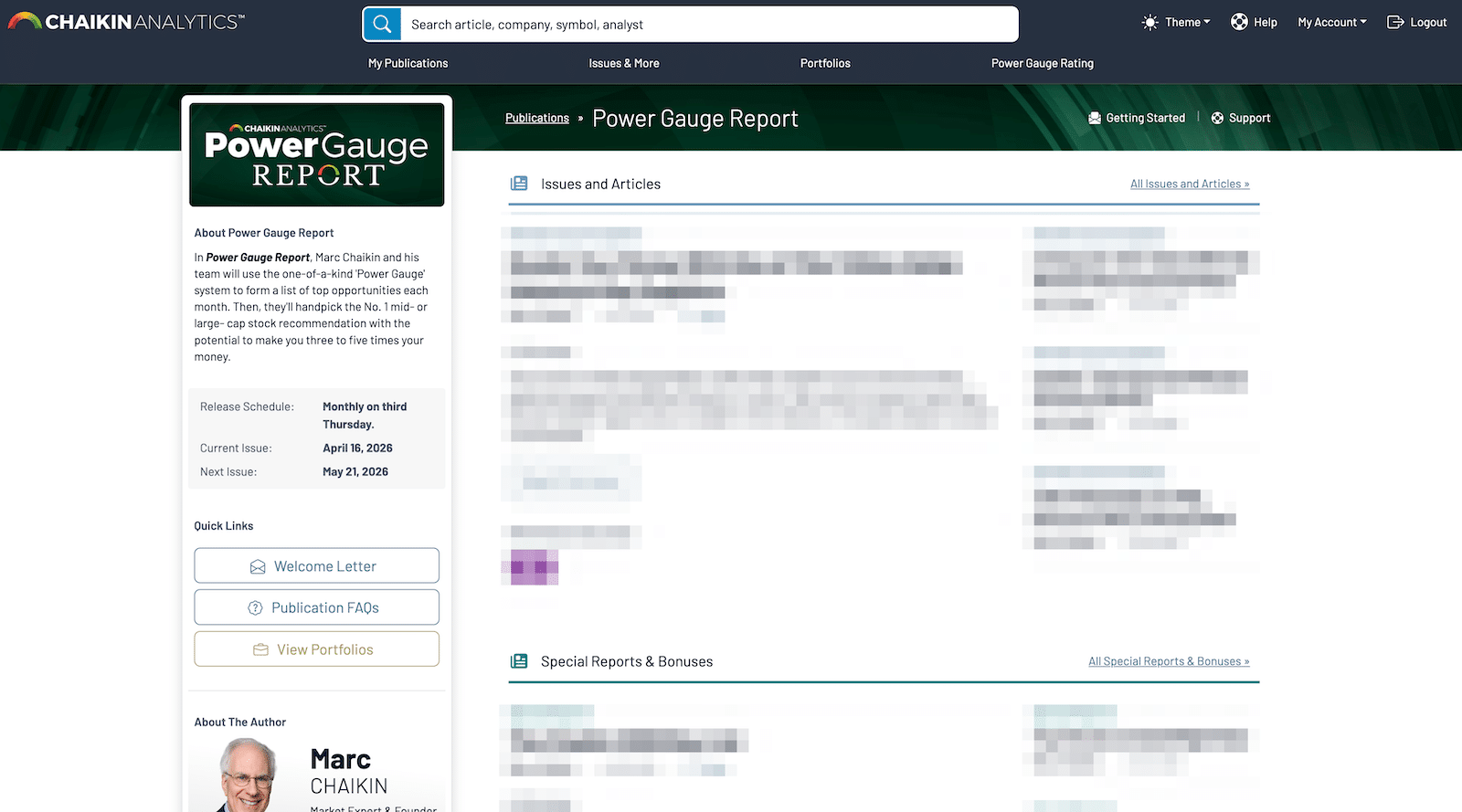
The service was launched by Marc Chaikin’s company, Chaikin Analytics, in 2021, and it’s typically the first product many people start with after watching one of his presentations.
(2) Who Is Marc Chaikin?
According to his own site, Marc Chaikin is a veteran market analyst with decades of experience. He is best known for creating widely used indicators such as Chaikin Money Flow and for developing the “Power Gauge” system that Chaikin Analytics is built around.

In his presentations, Chaikin often points to past predictions he believes helped investors avoid major drawdowns, while also highlighting the strong performance of some of his top stock picks.
He credits much of this to the Power Gauge rating tool he created.
His core message is simple: today’s market can be hard to navigate, but his Power Gauge uses a multi-factor rating system to help narrow the field and focus on stocks that currently look stronger.
It’s a compelling story, but the real question is how the Power Gauge works in practice, and whether it’s the right way for you to find stock ideas.
(3) How Does the Power Gauge Work?
At its core, the Power Gauge is a multi-factor rating system. It scores stocks using a basket of inputs (fundamentals, earnings, technicals, and other market signals), then rolls that into a simple rating of bullish, neutral, or bearish.
You also get a breakdown of how the Power Gauge rates a stock’s financials, earnings, and technicals, plus some analyst context and charts.
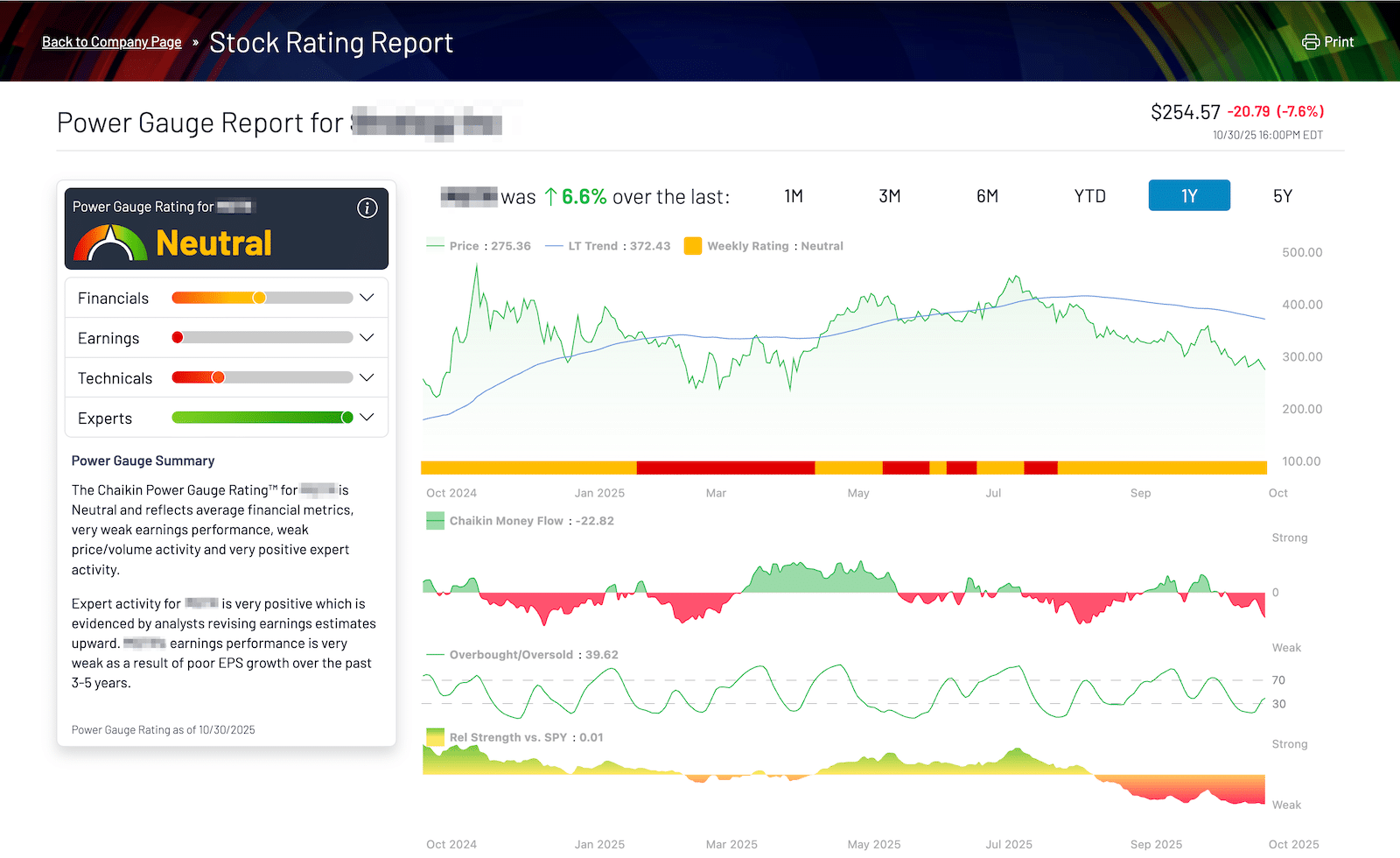
The key thing to understand is that Chaikin’s Power Gauge is designed to be a filter and a ranking tool, not a guarantee. In other words, it’s trying to help you narrow thousands of stocks down to a shorter list that fits the model’s criteria right now.
That can be useful if you like a more active, data-driven process. But it also means the “best” stocks can change as the signals change, which naturally pushes you toward ongoing monitoring and decisions rather than a simpler, conviction-driven approach.
(4) What Do You Get (and What Does It Cost)?
Once you join the Power Gauge Report, you get access to the core components of the service: the monthly newsletters, the model portfolio, and the Power Gauge rating tool.
Here’s a quick overview of what the membership includes:
- Monthly stock recommendations: Each month, subscribers receive a new stock pick based on the Power Gauge rating system, along with a write-up explaining why the stock currently stands out.
- Model portfolio: Members can view open positions, entry prices, and updates on how the recommendations are playing out over time.
- Power Gauge rating tool: This is the centerpiece of the service. By entering a ticker, members can see a color-coded rating based on the 20-factor model, along with supporting details that show whether a stock’s profile appears to be strengthening or weakening.
- Alerts and updates: Subscribers receive alerts when Chaikin believes something meaningful has changed with a stock, including updates that may affect existing positions.
As for price, the standard list price for the Power Gauge Report is $499 per year. However, Chaikin Analytics runs promotions often, so the first-year price may be lower depending on the offer you see.
The service also comes with a 30-day refund policy, which gives you time to explore the tools, review the model portfolio, and decide whether the system fits your investing style.
After joining, you’ll likely be shown optional upgrade offers. Some of these add-ons are priced at $5,000 per year each (examples include Power Gauge Investor, PowerProfits, PowerTactics, and Smart Money Trader), plus other services. These upgrades are optional, but the promotions are ongoing once you’re in their ecosystem.
(5) Is Chaikin Analytics Legit?
Chaikin Analytics is a real, established platform built around Marc Chaikin’s Power Gauge system. It’s not a fly-by-night operation, and the service itself is a structured tool that rates stocks based on a defined methodology.
That said, a service can be legitimate and still not be the right fit for every subscriber, especially when it’s promoted in a bold way that doesn’t always set the right expectations.
I think that’s also reflected in the company’s current Trustpilot rating:

I don’t treat review sites as the final word on any investment product, since they often reflect people who had a strong experience one way or the other. But in this case, the rating does support a broader point: Chaikin Analytics may be legitimate, but that doesn’t mean the service will match the expectations of everyone who joins.
So the real question is not whether Chaikin Analytics is a scam. It’s whether the Power Gauge Report is the right fit for you.
(6) Is the Power Gauge Report Worth It?
The best way to judge a service like this is to look past the marketing and see what the actual recommendations look like inside the member area.
When I checked the Power Gauge Report model portfolio, the open positions showed a mixed picture. One position was up around 200%, which is impressive. But there were also several smaller gains and losses across the portfolio.
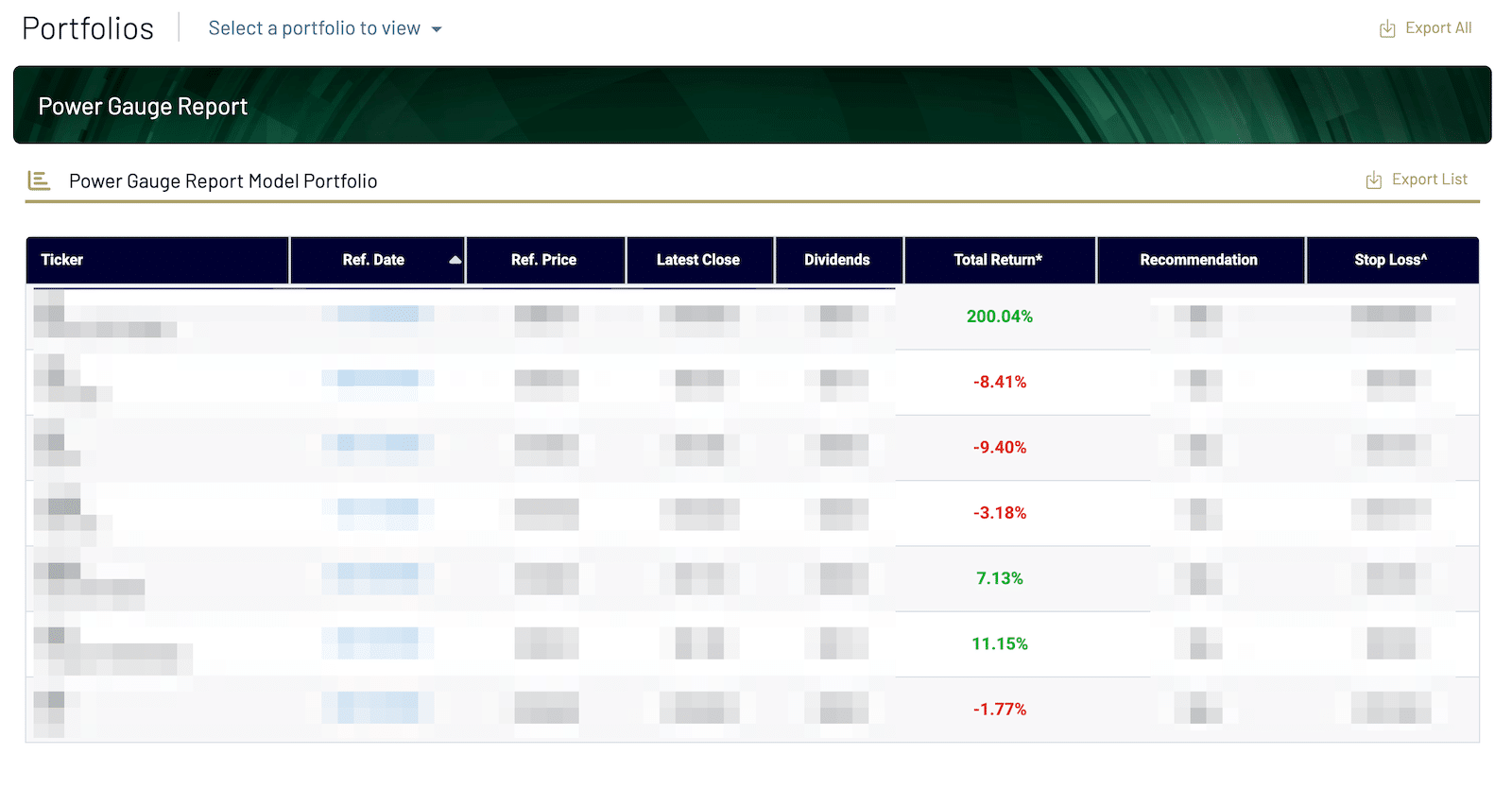
I also went through the archived sell alerts to get a better sense of the closed positions so far in 2026, since there’s no closed-position performance summary inside the model portfolio.
The results were mixed there as well. There were some strong gains of around 41% and 42%, alongside losses of around 16%, 28%, and 7%.
That is not necessarily bad, but it does show this is not a “can’t miss” stock-picking system. Like most services, the Power Gauge Report has winners and losers, and the value depends on how actively you follow the system.
So, is it worth it?
If you want a data-driven system and you’re willing to use it actively, you may find value in the Power Gauge Report. But if you’d rather focus on a smaller number of selective, high-conviction opportunities, there may be better options to consider.
Is There a Better Alternative?
After reviewing hundreds of stock advisory services, I’ve learned that it can take just one exceptional stock, bought early, to make a life-changing difference.
And that’s why Alexander Green is worth paying attention to.
Green recommended Nvidia when it was trading for less than $1 per share, split-adjusted. He also recommended Apple, Netflix, and Tesla before they became market giants.
Now, he believes artificial intelligence is creating another rare window of opportunity.
And he says the biggest potential isn’t in the famous AI stocks everyone already knows about. It’s in a handful of smaller, lesser-known stocks positioned for the next stage of the boom.
If you want to see what Green is recommending now, you can watch his new interview with Bill O’Reilly, where he reveals his top 3 AI stocks for 2026, free of charge.
Get the details and tickers here: