Hello, and welcome to my review of Stansberry Research.
Stansberry Research is one of the biggest names in the investment newsletter world. If you’ve seen their ads online, you’ve probably noticed two things right away: they make bold promises, and they sell a lot of different services under the Stansberry brand.
That’s exactly why it can be confusing to evaluate. “Stansberry Research” is not just one newsletter. It’s a publisher with multiple editors, multiple services, and multiple price points. So whether it’s worth it depends on what you’re actually buying and what kind of investor you are.
In this review, I’ll keep it simple and focus on the 6 key things to know before joining, including what it’s about, how it’s performed, whether it’s legit, and who it’s best for.
I’ll also share my number one recommendation, a service with a long track record of identifying under-the-radar opportunities early.
See My Top Recommendation(1) What Is Stansberry Research?
Stansberry Research is a financial publishing company that sells paid investment research subscriptions for self-directed investors. It was founded in 1999 by Porter Stansberry (who later retired from day-to-day operations in 2020).
Today, Stansberry operates as a publisher with multiple editors and 30+ research services. Its flagship paid service is Stansberry’s Investment Advisory (currently led by Whitney Tilson), and it also runs a free daily email newsletter called the Stansberry Digest.
In practice, most people enter through a specific free newsletter or entry-level paid service, and then choose additional services based on their goals and interests.
Stansberry also claims over a million readers/subscribers across its audience and says it’s made 24 “10x” recommendations across its research history.
(2) Who’s Behind Stansberry Research?
Stansberry Research isn’t built around one main analyst. It’s a publisher that sells research from a bunch of different editors, each with their own strategy and style.
Stansberry lists well over a dozen analysts and editors on its website. Some of the more well-known names include Whitney Tilson (Stansberry’s Investment Advisory), Dr. David Eifrig (Retirement Millionaire), and Dan Ferris (The Ferris Report and the Stansberry Digest).
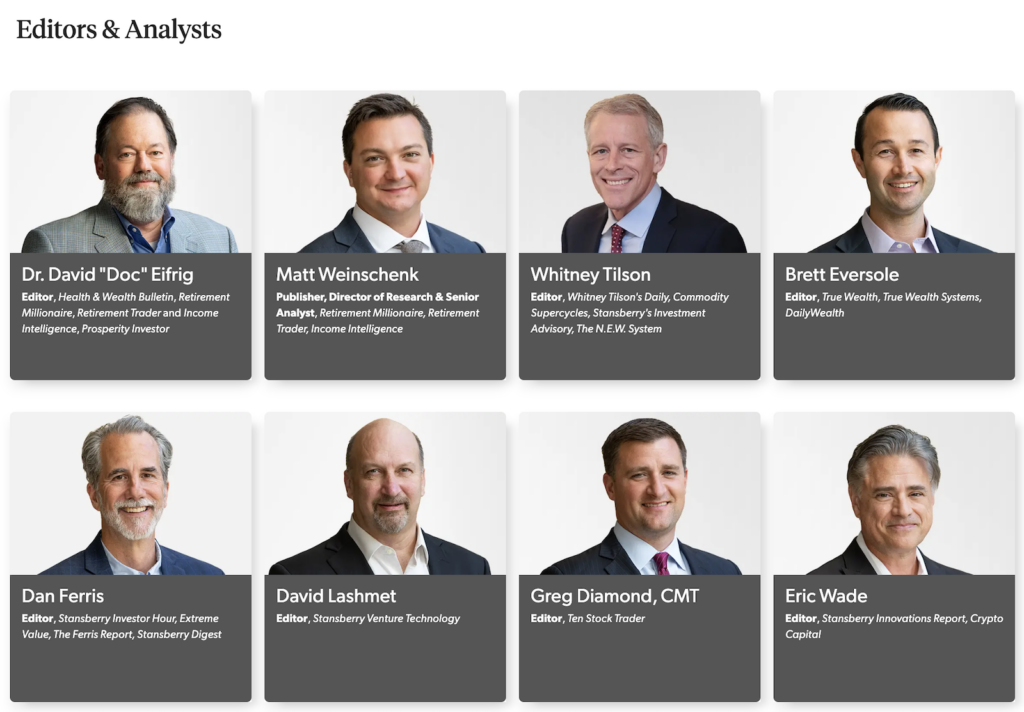
What that means for you as a subscriber is that when you buy “Stansberry Research,” you’re really buying one specific editor’s approach, not one unified Stansberry system.
Each editor has a different background, a different risk tolerance, and a different way of selecting ideas, so the experience can vary a lot depending on which service you join.
That said, the company’s flagship service is Stansberry’s Investment Advisory, which is headed up by former hedge fund manager Whitney Tilson. This is the most popular paid service, and it’s the place most people get started.
(3) What Do You Get (and What Does It Cost)?
What you get when you join Stansberry Research depends on which subscription you choose, but the way the services are structured is usually quite similar.
Most paid subscriptions usually include a monthly newsletter with specific stock ideas, a model portfolio listing all of the current recommendations, and research reports detailing each stock the editor recommends.
Subscribers also get access to a members’ area website that contains all of this, and receive email alerts if and when anything changes with the recommendations.
Entry-level subscriptions are often $499 per year (or less through different promotions), while higher-tier products can cost $5,000+ per year, depending on the service and what’s included.
And as for refunds, some offers come with a 30-day refund window, while others may have different terms depending on the specific service and promotion.
(4) How Has Stansberry Research Performed?
Because Stansberry is a publisher with lots of different services, there isn’t one single “Stansberry track record.” Performance depends on the specific newsletter and editor.
That said, Stansberry does publish an annual internal “Report Card” that grades several of its portfolios. And in its 2025 Report Card coverage, it says its flagship Stansberry’s Investment Advisory has beaten its benchmark by 3.2% per year since inception, and that Tilson’s 12 picks for 2025 produced an average annualized gain of 33.8%, compared with 24.9% for the S&P 500.
The fact that they share that is a good sign, because it gives prospective subscribers something concrete to evaluate instead of relying on marketing alone.
However, the results you’ll experience will come down to which service you join, whether you follow the recommendations consistently, and what the market does during the period you’re subscribed.
(5) Is Stansberry Research Legit?
Stansberry Research is a legitimate financial publisher in the sense that it’s a real company selling paid research products that many investors have subscribed to over the years.
That said, whether it’s worth it depends heavily on the specific service you buy and what you expect going in.
The biggest thing to understand is that Stansberry’s business model is built around marketing and multiple products. Many people first encounter the brand through a specific promotion, then later see offers for additional subscriptions.
Some subscribers like having lots of research options under one umbrella. Others find it frustrating because it can feel like there’s always another “next” service being pitched.
From an investment standpoint, you shouldn’t expect any newsletter (Stansberry included) to deliver consistent wins. Some recommendations will work, others won’t, and the value comes from whether the research process fits your style and you’re willing to follow it over time.
(6) Who Is Stansberry Research Best For?
Stansberry Research is best for investors who want ongoing stock ideas and market commentary, and who don’t mind choosing from a wide range of services depending on their interests.
It tends to fit people who are comfortable reading research regularly, following updates over time, and picking an approach that matches their style (long-term portfolios, income and retirement, sector themes, or more active trading).
On the other hand, it may not be ideal if you want something simple and focused, without having to sort through different products or decide which “tier” makes the most sense.
If that sounds like you, there may be better options to consider.
Is There a Better Alternative?
I’ve reviewed hundreds of investment newsletters over the years, and while many are built around big themes and bold predictions, only a small number take a more selective approach to uncovering exceptional opportunities before the crowd catches on.
One analyst whose work has stood the test of time is Dr. Mark Skousen.
Skousen is a veteran economist, bestselling author, and former CIA analyst who has spent decades in elite financial circles.
Over the past four decades, he has built a long-standing reputation for spotting major trends and investment opportunities before they become widely recognized.
Right now, Skousen is focused on a little-known SpaceX play that he believes could be like investing in Tesla in the early days, and he just released a new presentation showing how ordinary investors can get positioned early, before the broader market catches on.
Click here to watch the full presentation now (free ticker revealed):